
It’s not fair to call Doggo a snob but he knows what he likes. Two walks a day followed by a couple of decent meals, a mid-afternoon snack, a comfy sofa and a human hand to rub his ears. Or his belly. That’s pretty much it.
He is less keen on clambering into the back of the car, especially since the demise of my Ford C-Max, which blew up on a Devon road, and the arrival of the smaller, whinier Renault Clio.
“It is a sardine tin on wheels,” he insists. “It makes me vomise in the back as you swing round those corners.”
“At least it’s French,” I remind him.
“This is true. The French make the best cars.”
We agree to differ on this but Doggo, who is a French hunting dog mix of Brittany terrier and griffon, is more adamant about where he wants to go on holiday: Marseille. Every time I mention that we are going to take a road trip, it’s the first thing that comes up.
“It is the most beautiful city in the world with the finest football club on the planet. Allez OM!”
“Doggo, you don’t know anything about Marseille. You were born there but you’ve never been back. You’ve no idea what it’s like. So much traffic. No decent walks, terrible for a dog.”
“Bof I don’t expect you to understand but Marseille, c’est mon essence.”
“Well I’m sorry to disappoint you,” I said. “But we are going to Normandy.”
“Normandy? You cannot be serious. This is Viking territory. Bumpkins and ruffians.”
“Doggo, you spent six months in Cornwall. This is puppy’s play.”
And with that he let out a long sigh, slumped on to his belly, rested his head on his front paws and looked wistfully out into the garden.

A couple of hours later we had left the Ile de France behind us and were heading into the flinty skies and stair-rod rain of western Normandy, the region they call La Manche.
This is not the Normandy that collars the world’s attention every June 6: the Allies landed their D-Day troops on beaches along the northern coast to the west of Dieppe. We were heading further west towards the beaches that look across to the Channel Islands: La Manche.
Leaving aside the numerous trips to the ferry ports, I hadn’t been out that way for years, not since I went camping with my parents in the summer of 1980 when we tootled around Normandy and Brittany for a couple of weeks. We would stop at various churches, syphon off the holy water which was later added to the whiskey in a form of benediction. I recall sitting outside the camper van listening to the BBC Long Wave news on the radio. It was the summer of strikes in Gdansk. Everyone was talking about this little man Lech Walesa: the walls of the Soviet Empire were starting to crumble.
I tried explaining all of this to Doggo but since I had strapped him into his safety harness on the back seat, he had turned the lights out and gone to sleep. So I didn’t bother telling him that there was a family element to our trip out to La Manche. Not the Spender family directly, or indeed my mother’s Cookson side but the Champernownes.
Let’s track back a little. It’s ancient history after all. Some of it anyway.
My grandmother on my father’s side was born Helen Frances Champernowne at Dartington Hall in 1878. It had been the family seat since 1559 when Sir Arthur Champernowne, Vice-Admiral of the West under Elizabeth I, of the Ilfracomebe line of Champernownes – as opposed to the Umblerleigh line – acquired it as an alternative to Modbury Manor.
It would stay in the family for 366 years until 1925 when, in increasing decay, it was sold off to Leonard and Dorothy Elmhirst who spruced it up and opened it as a school. The closest I have ever got was as a paying tourist.
To take a further step back in time, the Champernownes had come to England in the 11thcentury. According to the family history compiled by Elizabeth Champernowne – otherwise known as Great Aunt Bessie – which she completed in the 1950s, “everything points to a Jordan, born about 1090-93 being the first Champernowne actually resident in England”.
Jordan, however, was not the first of the Champs to set foot on Albion’s green and pleasant land. That honour likely fell to Thomas de Cambernon who hopped a ride with the Bishop of Coutances to fight at Hastings alongside the Duke of Normandy, or William the Bastard to give him his informal title, in his bid to claim the crown of England. It’s fair to say that Thomas wasn’t the last of the line to work with a bastard in the thousand years since.
You will have already seen the connection. The name Champernowne derived from Cambernon, which was where Doggo and I were heading.
It was pure curiosity on my part. Evidently there would be no direct connection with the ancient family, no stone to touch that might have felt the graze of, say Beatrix de Cambernon, who was buried in Caen Cathedral in 1280, already almost 200 years after the Bastard – or King William I of England – had been laid to rest; no bridleway where Jourdain, Seigneur of the fief, may have lead his horses while he was top dog in, wait for it, 902.

And yet, probably due to my overactive, romantic imagination, I felt at home, as if this was now my own fiefdom. I felt Norman, I felt Viking. My view of the Battle of Hastings shifted. We were the invaders. For the first time I felt as if my lot were on the winning team.
The locals, sadly, were distinctly underwhelmed: no fattened calf (or vegan equivalent) for the return of the prodigal seigneur. But I suspect they were blow-ins, not true Normans, so I let it rest.
The village lies about five kilometres from Coutances and its stunning twin-towered gothic cathedral: I wonder if the Cambernons were at the consecration of the first iteration in 1056, or indeed the second in 1274.
Coutances has sprawled a bit over the last hundred years but there is a nice buzz around the cathedral and high street while the annual jazz festival brings in plenty of visitors.
Cambernon, in contrast, is a total backwater. A population of about 708 – according to the 2021 census – of whom I saw about nine during the five days we were there. I heard lots of kids as it has a large primary school for all the villages around but saw none. There is no café, no bar, no boulangerie, no epicerie, no commerce whatsoever which means it has no real heart.

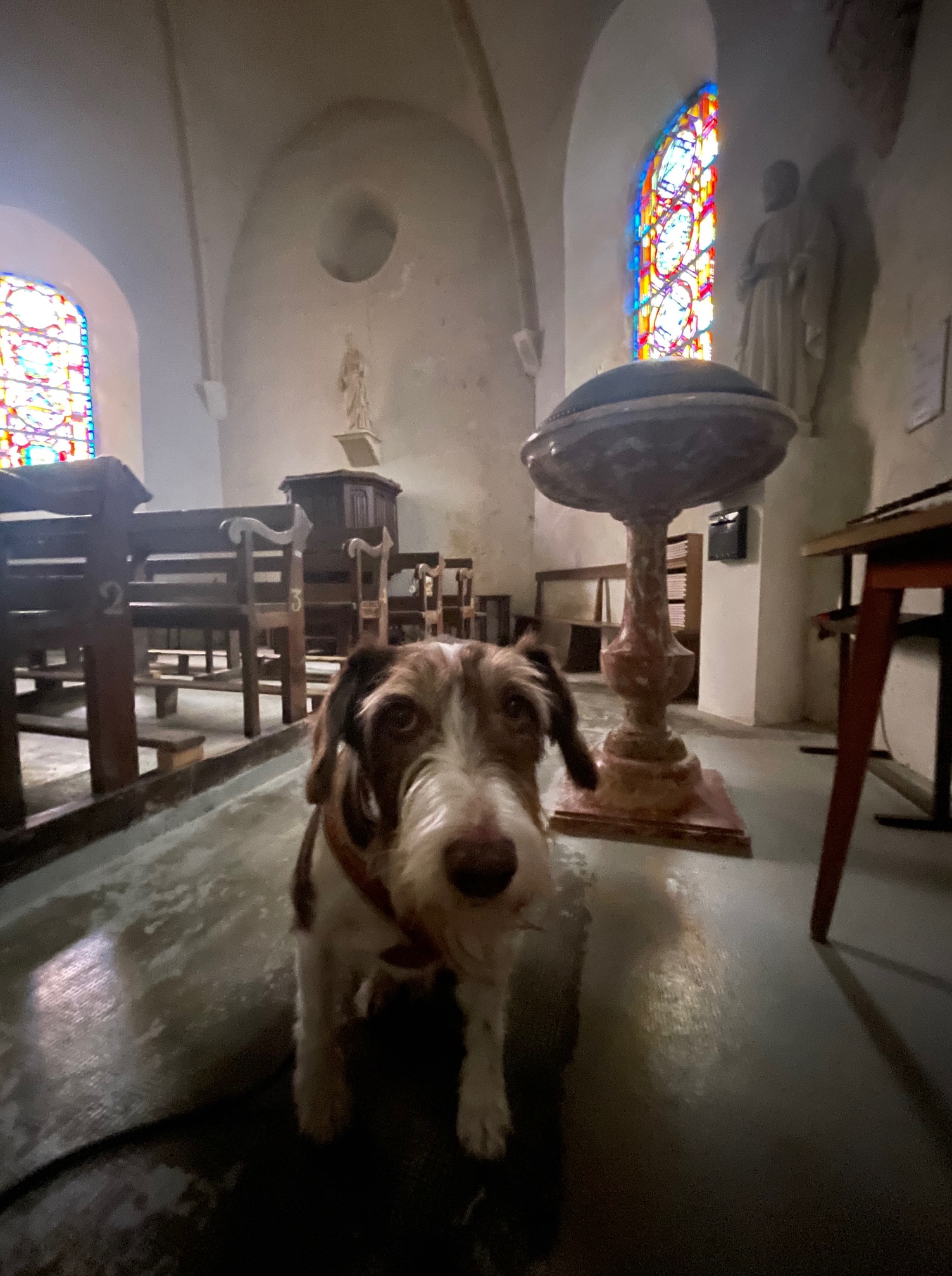
The church takes centre stage, standing halfway up the hill which spirals through the village. The current Notre Dame de l’Assomption dates from the 13th and 14th centuries but it appears to have replaced a chapel on the same site which was linked to the medieval chateau, which would have recognised Champernownes on bended knees.
The statue of Virgin and child dates from between 1350 and 1370 and is apparently a replica of the statue at the Abbey of Mondaye near Bayeux. The graves in the churchyard are all relatively modern and there is, needless to say, the memorial that you find in villages the length and breadth of France to honour the fallen of the two world wars.
The original Cambernon family chateau disappeared many centuries ago, replaced in medieval times by another, although this would have been after the time of the Cambernons.
“In 1913 and 1914 our cousin, the late James Frederick Williams, corresponded with Monsieur Pierre Duprey who lived at Cambernon and had devoted twenty years to the history of the place, and he said that there was then no trace remaining of the original chateau,” wrote Aunt Bessie in her history, which is dated 1953.
“But it seems there were some remains of a castle, of a somewhat later date, nearby, which formed part of a farm. And the Reverend Richard Champernowne (who died in 1890) visited the place with his daughter (later Mrs Wigan) and ‘climbed up the little turret staircase, almost impassable from generations of rooks’ nests, and coming out at quite a good height, surveyed the country’.”
The turret and much of the farmhouse which was built on the site of the medieval chateau have also gone, victims of the bombardment from both Americans and Germans that took place in July 1944 during the Battle of Normandy as they battled for control of the main road from Coutances to St-Lo.
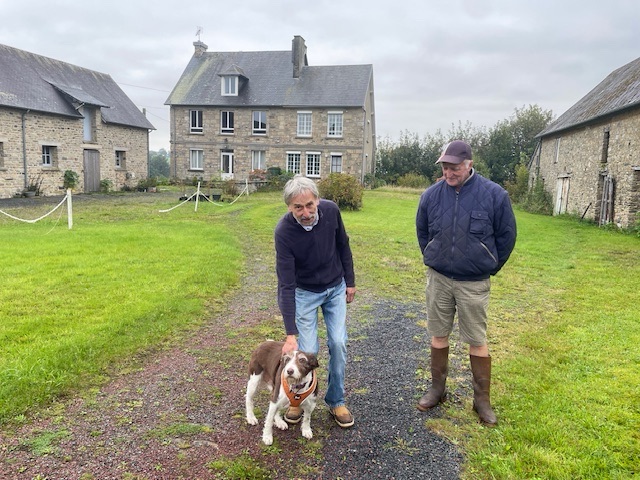
I did visit the site, however, where the joint-owner Michel, who was born in a makeshift portawagon in 1945 in front of the smoky remnants of the house where the Americans had set up a small camp, showed me around the back to the space where the turret once stood.
I know it’s been gone a long time but I did for a moment picture the Reverend Richard arriving in similar excitement to myself, looking for traces of the past, and climbing past those rascal rooks’ nests.
Michel was keen to show us the site of that old turret, taking us behind the house and presenting the top end of an open field.
“Here. This is where it was,” he said. “Nothing now. Boom. All gone.”
As Doggo put his snout into a hedge and Michel rolled himself a cigarette, I stood quietly trying to commune with a thousand years of history. If there was nothing tangible in the connection, there was something, how should we say, spiritual about being in Cambernon.

The topography was, I imagine, much the same as it was in Jourdain’s day: soft, rolling hills, greened up by the summer rain and home to slow-moving Normande cattle whose milk is the key to so many outstanding butters and cheeses. When you next slice into a Camembert, hopefully with a glass of Normandy cider at your elbow (Somerset will do if Normandy isn’t available), give a moment of thanks to the Norman cows.
It is easy to see why someone from Normandy would feel at home in the south-west of England and vice versa, whether that is in the 11th century or the 21st. The countryside is remarkably familiar as are the trees and the high hedges that line the small country roads. Perhaps that is why I too felt at ease.
Cambernon was never a pumping centre of industry which means that today’s sleepy hollow may not be that far removed from the collection of dwellings and farm workers who busied them there back in Jordain’s day. But it remains a lovely village. Our village. Even Doggo approved.
Doggo and I stayed in this Gite in Cambernon
In Part 2 Doggo heads to Cornwall…
@ Barney Spender 2025
 One Man and His Blog