
There are times, I am sorry to say, when Doggo doesn’t want to chat. Normally happy to shoot the breeze in his own flap-eared fashion about the never-what-will, he will occasionally settle down, his head between paws, lock down the peepers and throw away the key. This happens most often after dinner, which is entirely reasonable, when he might prefer to stretch out on the sofa, and when he is in the car, which I am afraid I find most out of order.
“It’s a long drive Doggo, I could use some company, some conversation,” I plead.
“Why don’t you listen to the cricket on the radio?” he answers. “You prefer the cricket anyway.”
“It’s not the season Doggo. A wet Monday March morning is hardly the moment. No sport at all I don’t think.”
“The Archers, then.”
“That’s not till this evening.”
“One of those history programmes then, you liked that one about William the Conquerant didn’t you.”
“So you’re really not going to talk to me.”
“Non. I sleep. Wake me when we get there. In fact, don’t bother. The smells will rouse me.”
This is a setback. We are driving from St Just at the western tip of Cornwall to a little place called Loveston, near Tenby, almost the south-western tip of Wales. As the crow flies it is only about 100 miles, but according to Waze, which is giving us a six-hour drive, it’s about 340 miles (550 kilometres) by road. It’s roughly a 200-mile drive north-east up to Bristol, a dog leg left followed by 140 miles west along the south coast of Wales all the way into Pembrokeshire. Roughly: don’t quote me on those numbers.
There is talk of a new ferry which would cut the travel time: Swansea’s Labour-led council announced in April 2025 that it was planning a new green-powered ferry service over the Bristol Channel to Devon and Cornwall. But there is no date, no budget, no firm proposal, so don’t hold your breath. Unless you’re planning to go underwater.
I won’t let Doggo sleep the whole way: we will make a pee-stop when we cross into Wales probably the M4 Cardiff Gate services just after Newport. He likes to hop out, and gulp down some water, which he then redistributes to an assortment of trees, bushes and bins as he takes a short gander alongside the motorway.
I will miss his chat, though. I do realise that people without dogs will put me down as barking mad (sorry about that one) but dog people will understand the reality and therapeutic powers of conversation.
“Dogs can’t talk,” the non-dogs will curtly point out before returning to the screen in front of them, imagination and sensibility choked at birth. But we really do talk to our dogs, and we hear their replies.

When Jac was sick, Doggo was nurse and confessor to all of us. In turns, Syd, Nat or I would take him down to the Seine and go over our worries and sadness about the brain tumour that was torturing Jac. I recall one day, shortly before the end, when we sat on a rock looking out over the river where so often we had watched Jac on her paddleboard, and I wept into his neck. He nuzzled his pointerish nose under my chain and invited me to wrap my arms around him. He didn’t speak then, he listened.
And when we got home he hopped up on to the bed and did the same for Jac. He nursed us then; he nurses me still.
He was as heartbroken as the rest of us when Jac stepped through the gate, and embraced Celtic tradition by getting drunk on the day of her funeral. Someone had left a pint of beer on the grass. Doggo was thirsty. He polished it off and then sloped off to sleep under a bush. He wrote a short poem which summed it up nicely:
“A wake,
Not awake.”
(@Doggo, 2019)
Pembrokeshire has been a part of my life since 1997 when I first started going out with Jac, who was born in Haverfordwest and schooled in Letterston and Fishguard. My first visit, however, was not until the following spring when I was about to take over as Editor of the British Regional Airlines magazine ‘Skylines’ which was in desperate need of a makeover.

“Why don’t you stick Taffy Spice on the cover?” suggested the editorial director – and my old school pal – Rupert Bates. “She’s a fine looking woman. We can find a photographer and you can go down to Wales for a couple of days. Find a castle or something. They’ve got some good castles down there.”
Fortunately Jac (aka Taffy Spice) was game and so we pushed off down to Pembrokeshire with a South African photographer called John Parkin, who came to Britain after doing some wonderful work during the 1993 Mandela election. He took great photos and drove like a lunatic; strikes me that’s a common thread among snappers.
We stayed at the Waterwynch Hotel, as it was then, just outside Tenby and Jac took us on a tour of the area where we shot a variety of pictures: we went to Tenby, of course, Blackpool Mill and Brown’s Hotel in Laugharne which was a regular watering hole for Dylan Thomas. My favourite sequence was in the limestone ruins of Carew Castle where we had her glancing out across the river, waiting perhaps for her lost lover.
Carew became a special place for us: we took the kids there often and Doggo learnt the niceties of being a ‘pub dog’ in the Carew Inn just across the road. It’s still a fine watering hole.
On that first trip Jac had nervously introduced me for the first time to her parents, Patrick and Valerie.
“He makes terrible jokes,” she warned me as we waited in the Italian restaurant. “Thinks he’s Max Boyce.”
The jokes were a mixed bag but we laughed a lot that night and for many years afterwards, whether it was in Loveston or London, Greece or France.
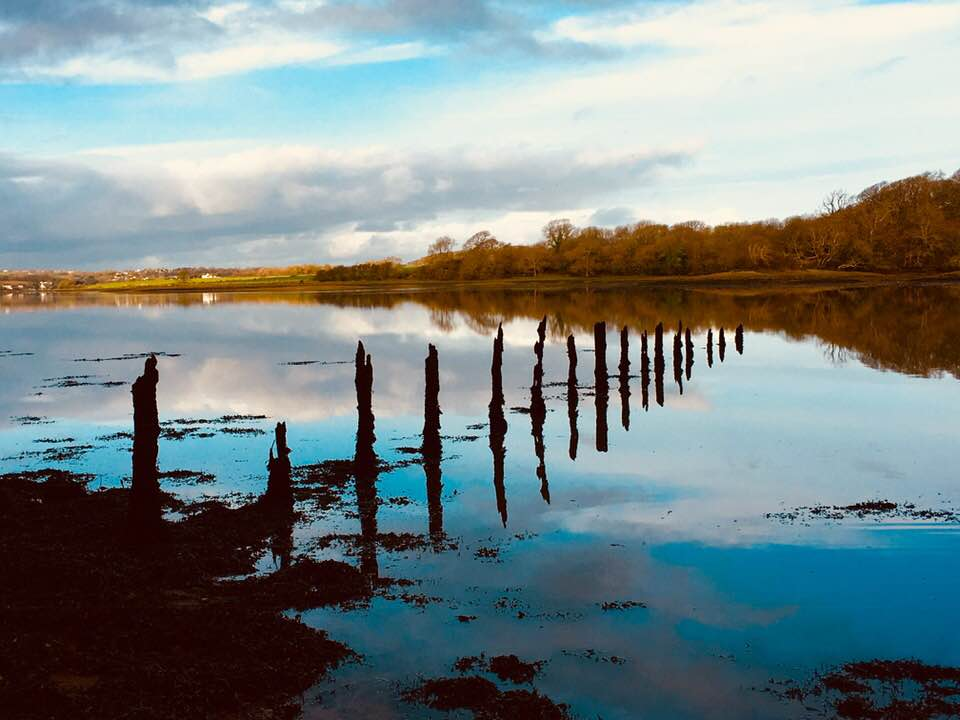
Less so in recent years. In 2017, Valerie was diagnosed with a brain tumour. We went over for Christmas, staying in a little cottage in nearby Lawrenny, another village with a magnificent pub, right down on the banks of the Cleddau. The river is busy enough with pleasure boats these days although Patrick, who is 86 now, remembers the sight of Sunderland and Supermarine Walrus flying boats that were stationed here during the Second World War.
Valerie’s death on June 7, 2018 was a heavy blow to all of us, most especially for Patrick. Jac broke down at the funeral as she read the Dylan Thomas poem ‘On Fern Hill’. None of us had any notion that she would also be gone within the 12-month, struck down by the same filthy cancer that took her mother.
I had always got on well with Patrick but the loss of these two powerhouse women brought me closer to my father-in-law. We chatted often, during Covid especially, and I try to get over a couple of times a year. I feel at home in Pembrokeshire. I am amongst family, not just with Patrick but with multiple strands.
Both he and Valerie are Pembrokeshire born and bred, Valerie from north of the Landsker Line – which traditionally separated Welsh and English speakers – and Patrick south.
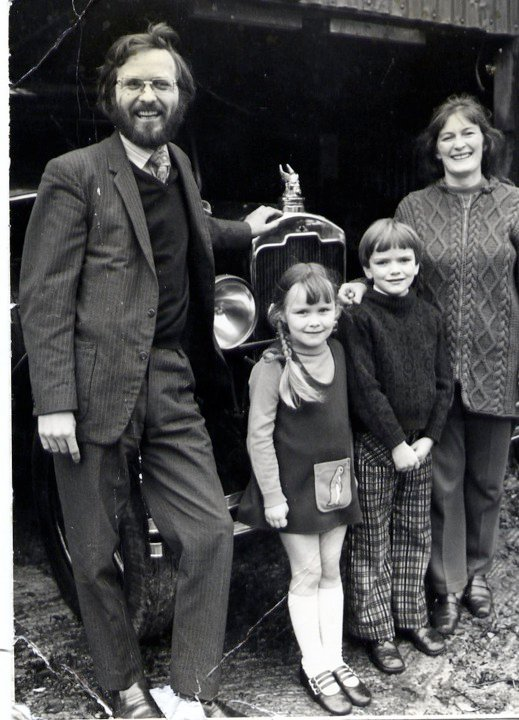
Patrick, indeed, was born in the house where he lives today in Loveston. His father was a tenant farmer when he was born in 1939. He revised for his O’Levels by candlelight and helped his mother as she catered for the paying guests they occasionally put up.
Patrick and Valerie have spent their entire lives in Pembrokeshire, immersing themselves in the history and culture of the county while also getting involved in daily life. They organised Meals on Wheels, often helped out people who needed a ride: Patrick stood at three General Elections as the Liberal candidate for South Pembrokeshire.
“It was a busy time,” says Patrick who was also working full-time for the NHS. “We had (Liberal leader) Jeremy Thorpe come down to see us. Just as well we locked the dog up,” he quips, unable to resist.
In February and in October 1974, the Liberal vote went up but not by enough to send him to Westminster which is a shame because he is a good man. He would have served his constituents well. It was the same story when he ran again in 1987.
I was telling Doggo this, although I think he was still asleep at the time, when we crossed over the Prince of Wales Bridge and I reached for the dial to switch to BBC Cymru. I don’t speak Welsh, not a word, but I love the sound of the language; it has a lilting, lyrical flow which immediately takes you into the soul of the country. I do the same when I get to Greece. I need to hear Greek.
Doggo and I spend a week in Pembrokeshire, catching up with Patrick and making the most of the clear skies, low sun and empty beaches.
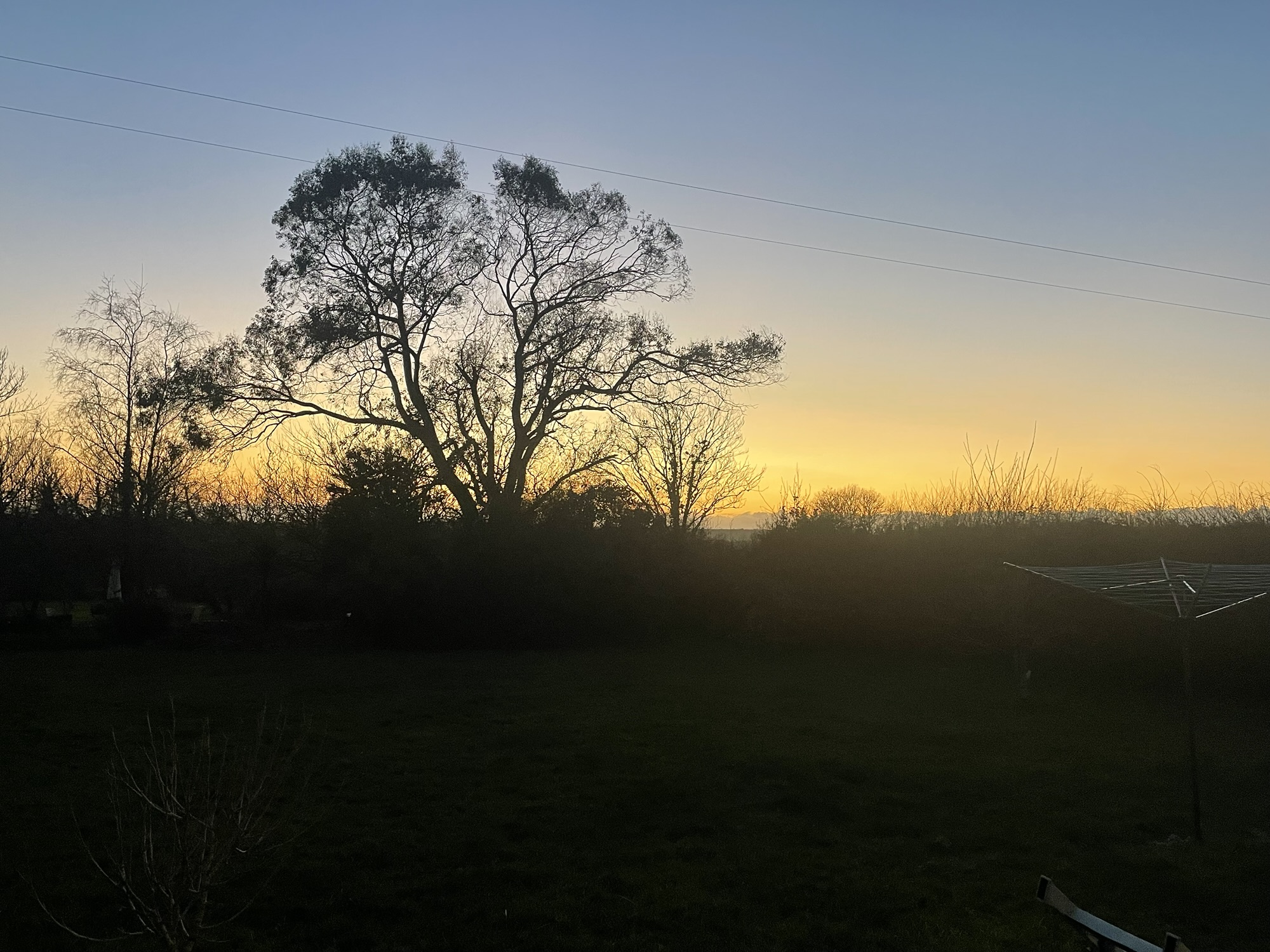
At the house we occasionally lapse into reminiscence; it’s inevitable and something we both treasure. Talking about the past brings back Valerie and Jacqueline. We don’t talk about the nightmares that we lived through as they struggled with their cancers but the daftness, the foolishness, the laughter.
As I look at where we are sitting in the conservatory that looks out across the ‘Jensen Button Patio’ to the sunset away in the west, the faces flicker in front of me: Christmases here with the kids, family parties, that time when Jac’s brother Owen did himself a mischief while trying to demonstrate his version of the Drambuie Nipple.
For those who don’t know, this involves pouring a slug of Drambuie into a shot glass, setting fire to it and, as quick as you can, placing the rim of the glass over one of your nipples. The theory is that you create a vacuum, the flame expires through lack of oxygen and you get to unlock the glass and throw the Drambuie down your neck.
Except this didn’t quite work out.
Now Owen is a clever lad. He designs Formula One car engines. He knows his science.
To this day, no one has quite figured out what went wrong but it was quickly evident from the scrunched torment spreading across Owen’s face as he locked the shot glass over his nipple that someone – and let’s not name names here – had left the vacuum slightly ajar.
For a few moments he held on as he felt the lick of the flame’s tongue across his left nipple. Then it became too much. The teeth bit. The glass went flying along with burning Drambuie and he went a-leaping, grabbing Jacqueline’s wine glass and pouring the contents over his engorged and charred nipular area. Jac helped further by reaching for my half-drunk beer and tossing that over him as well.
Ever the scientist, Owen’s response once the laughter died down was typical: “I better do that again, work out what went wrong.” No admission of guilt.
Fortunately, we stopped him from singeing his other nipple and, as far as I know, he hasn’t pursued his studies further.
WALKING ON THE BEACHES
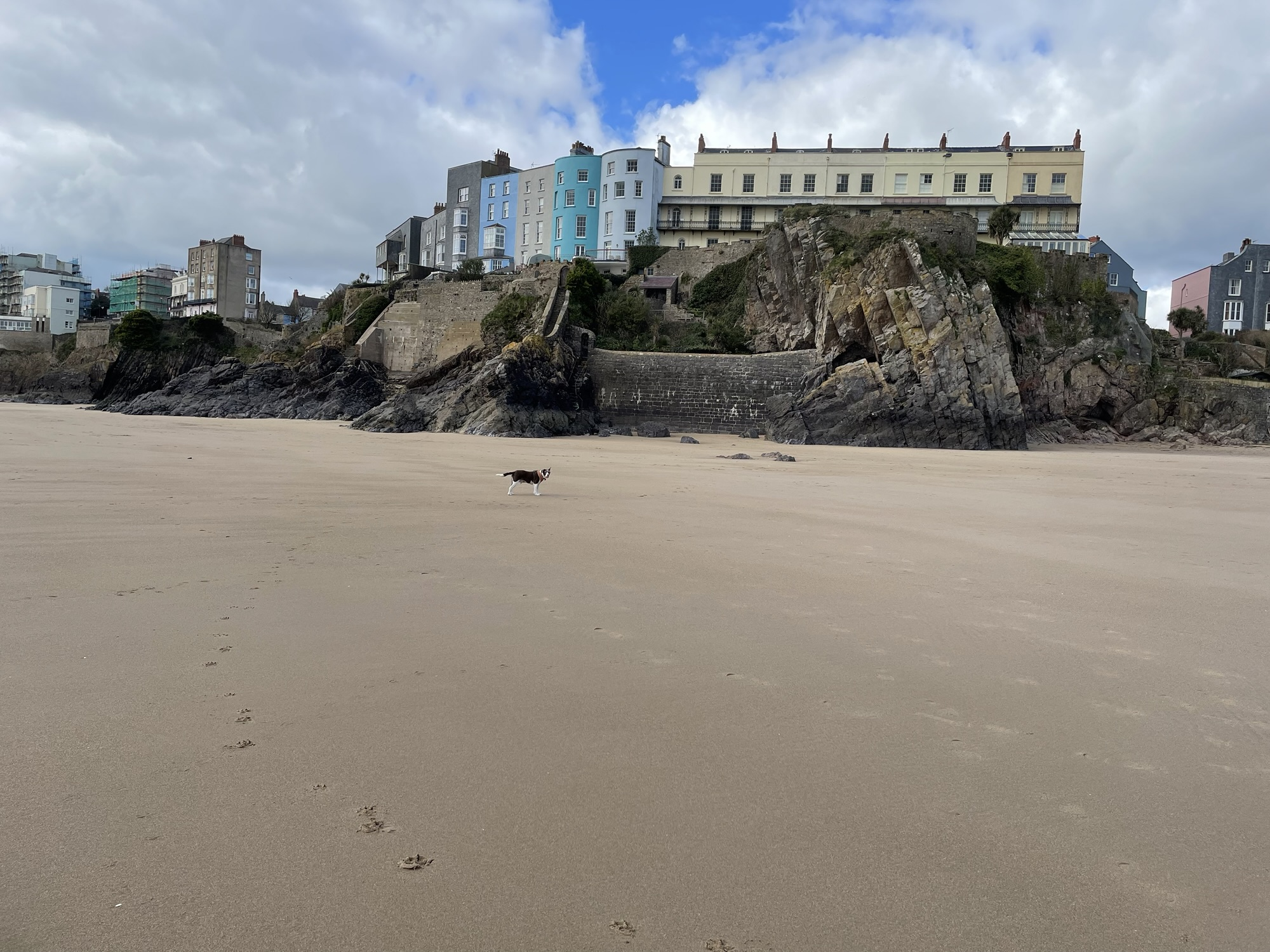
Tenby was aways a particular favourite on family visits and Doggo and I follow the urge to retrace our steps. We park next to the Sainsbury’s in town and then, staying outside the old fortified walls, we walk down to the line of hotels that overlooks the beach, take a right all the way down to South Beach. Here we hit the sand, a long flat beach, two kilometres back to St Catherine’s Island, which looks out across to Caldey.

I have swum here in the past but today is not the day. March is still a bit early for me but there are heads bobbing in the water. Doggo bimbles along happily, not getting too close to the water’s edge, preferring to sniff and pee close to the cliffs that rise up to support the town.
We make our way down to St Catherine’s Island which, even when it is not cut off by the water, never appears to be open and welcoming visitors, and veer towards the steps that lead you round the head, past the new RNLI station, and back towards the harbour, whose coloured houses give it the air of a child’s painting.
Whether it stirred the imagination of Roald Dahl is a matter for many a dissertation. The children’s author was a regular visitor to a cottage by the harbour called The Cabin when he was a youngster. “An Easter holidays is hardly an Easter holidays without Tenby,” he wrote in 1933. “We had donkey rides on the beach and long walks with the dogs along the top of the cliffs opposite Caldey Island.”
Dahl is not the only famous children’s writer to have chalked up Tenby on their bedpost: Beatrix Potter made a visit in 1900 and reworked the garden of her guest house in ‘The Tale of Peter Rabbit’.
Another writer, of more adult matters, Mary Anne Evans, otherwise known as George Eliot, stayed in a house at the bottom of St John’s Hill in 1856, apparently finding the inspiration to write her first fiction, three short stories that were gathered together to form ‘Scenes of Clerical Life’ (if you are looking for a first edition there is one for sale on Abe Books for a cool $23,000).
John Wesley was a regular visiting preacher but perhaps that is no surprise: Wesley put in the mileage when it came to spreading the word of the Lord.
And, of course, there is the ubiquitous Dylan Thomas who not only gave the first reading of ‘Under Milkwood’ in the now-demolished Salad Bowl Cafe above North Beach but also topped a monumental session in the Coach and Horses pub by leaving his only manuscript on a barstool. Fortunately for all of us, the landlord did the decent thing and saved it.
Book lovers will adore Cofion Books, the most remarkable of second-hand bookstores, which sits at the bottom of a set of steps on the corner of Bridge Street and Quay Hill. It is tiny and it is rammed with books, stacked high along the walls and on shelves down the middle. There isn’t enough room for two people to pass; we are instead like cars on a country road, backing up into a layby. And there appears to be no order to the books which in some ways is all the more glorious. You never know what you will find. The owner, Albie, however always seems to now where things are.
Tenby also has its place on the political history of England and Wales. In 1471, a 14-year-old Henry Tudor, who was born down the road at Pembroke Castle, escaped from Tenby to France, returning 14 years later at Mill Bay, not too far away, on the Cleddau to launch the House of Lancaster’s bid for the crown. At the Battle of Bosworth Field he successfully unseated Richard III, emerging as Henry VII.
As a kid growing up in a Royal Navy family, Horatio Nelson was one of my early heroes: it still gives me a schoolboy thrill to see that he came to stay in Tenby with Emma Hamilton (and her husband Sir William) in 1802.
“Oh, it’s always history with you isn’t it,” says Doggo who has got used to sitting quietly outside Cofion Books. “History and cricket that’s it. Why don’t you tell them more about the bitches.”
“The bitches?”
“Absolutely. Don’t you remember? The beautiful bitches at Pendine, Newgale, Solva…”
“Ah. Yes. You mean beaches. Not bitches.”
“That’s what I said.”
Doggo had a point, Pembrokeshire is so much more than cute little tourist towns.

At Pendine, we marched across the glistening flat sands which for many years in the first half of the 20th century witnessed the fastest vehicles in the world. It was here in 1924 that Malcolm Campbell set a world land speed record of 146 mph in his Sunbeam ‘Blue Bird’. That prompted a rivalry with John Parry-Jones from Wrexham who took the record beyond 170mph before dying in an accident on March 3, 1927 on the sands when Babs, his car, flipped as he attempted to go even quicker.
Babs was buried in the dunes but later exhumed and rebuilt. Occasionally she puts in an appearance but it’s a model of ‘Babs’ that holds centre stage in the Land Speed Museum just off the beach.
On it, Doggo and I walked for what could have been hours, except we were approached by two gentlemen in a Land Rover.
“Back,” said the first.
“Excuse me?”
“Turn around please sir and go back the way you came. You can’t come any further.”
My bemusement gave way to embarrassment. I had forgotten that the beach merged into Ministry of Defence land. We were walking in a weapons range. I had missed the bollards as we had been too far out, walking by the water’s edge. I apologised, pulled off a rapid about-turn and marched back towards safety. Doggo sniffed some seaweed, pretending he didn’t know me.
Newgale, on the west coast of Pembrokeshire, is another sandy stretch, almost two miles long, where dogs frolic – this was in March before the summer restrictions kick in – and humans fly their kites, launch their surf boards. And Solva is a pretty dogleg harbour where the tide runs so far out there is just a shallow trickle of water at low tide and the boats sit on the sand.
At Fishguard, we find the beach where Jemima Nicholas is said to have single-handedly stopped the French ‘invasion’ in February 1797, the last such invasion, it appears, of mainland Britain. The legend is that Jemima, armed with her pitchfork, not only rounded up 12 French soldiers and deposited them in the gaol, but also encouraged the women of the town to put on their red cloaks and high hats and march along the town walls. The thinking was that it duped the French into believing the town was well-garrisoned and their cause was in vain.

“I’m not sure what to make of this,” says Doggo. “These so-called Frenchmen can’t have been from Marseille. They must have been from Normandy: they are not so clever there.”
It is the old story that has survived beyond the history and we celebrate her chutzpah with a pint or three of the excellent Jemima’s Pitchfork at the Cresselly Arms, quite possibly the finest pub known to humanity. When Doggo isn’t with us and it’s raining, we sit inside, especially if there’s a fire going and rugby on the telly, but usually we are outside, sitting above the Cresswell River which flows into Milford Haven.
Sometimes Chris and Jenny, who used to be Patrick’s neighbours, will join us. They live just the other side of the river which is a short walk from the Quays when the tide is out, a longer one when it is coming in, something that happens disconcertingly quickly. Chris is an Aussie and enjoys arguing, mainly about rugby but really about anything. If there’s an opposite view, Chris will take it. These never escalate as the mutual appreciation of beer and laughter always shines through. When he’s not in the pub, he is often to be found in a canoe, enjoying the bounteous beauty of the river.
Patrick and I also stop in the Dyffryn Arms in Gwaun Valley, a whitewashed roadside pub that is better known as Bessie’s.

This refers to the late Bessie Davies who worked there for 72 years, right up until December December 2023 when she died at the age of 93. In the single-room bar, where her daughter draws off a jug of Bass and serves us a very decent pint through a small hatch, there is a picture of her gazing over at the Prince of Wales (later Edward VII) on the wall opposite.
In an age of micro-breweries, Bass feels like a throwback to the days when the big breweries dominated: Courage, Watney’s, Double Diamond and Bass, these were the ales from the 1970s and early 80s, occasioning the gag that when Paul Simon came to perform in Kilgetty he had Double Diamond on the soles of his shoes.
I would occasionally have a pint of Bass if I was feeling homesick when I was a student in Dublin where The Stag’s Head off Dame Street would serve it alongside the local Smithwicks. It’s not a fancy beer; it tastes of home and there’s the comfort of it.
At Bessie’s there is no piped music, no television and no Wifi: in fact it’s a mobile phone deadspot. Terrible for the screen addicts but great for the ancient art of conversation. Patrick, Doggo and I fall into chat with a couple of bikers, Gareth and Mervyn, probably both in the sixties. Mervyn is thin, well-groomed and dressed sensibly for a motorbike in March with leathers and all the gear. Gareth, meanwhile, is dressed for a summer’s day on the beach, his shorts exposing a powerful set of pit-prop calves that wouldn’t be out of place in the Narberth front row. His long hair is tied back and his beard still has its natural reddish colour, speckled only here and there with salt and pepper. I admire it jealously.
Gareth takes a long draft of his Bass.
“You were in the Cresselly Arms yesterday, weren’t you,” he proclaims.
As Patrick and I look at each other in slight bemusement because we had indeed been there but without seeing either of these two, Gareth continued.
“Well, I’m pretty sure it was you two but it was definitely him,’ he said, pointing to the prostrate hound.
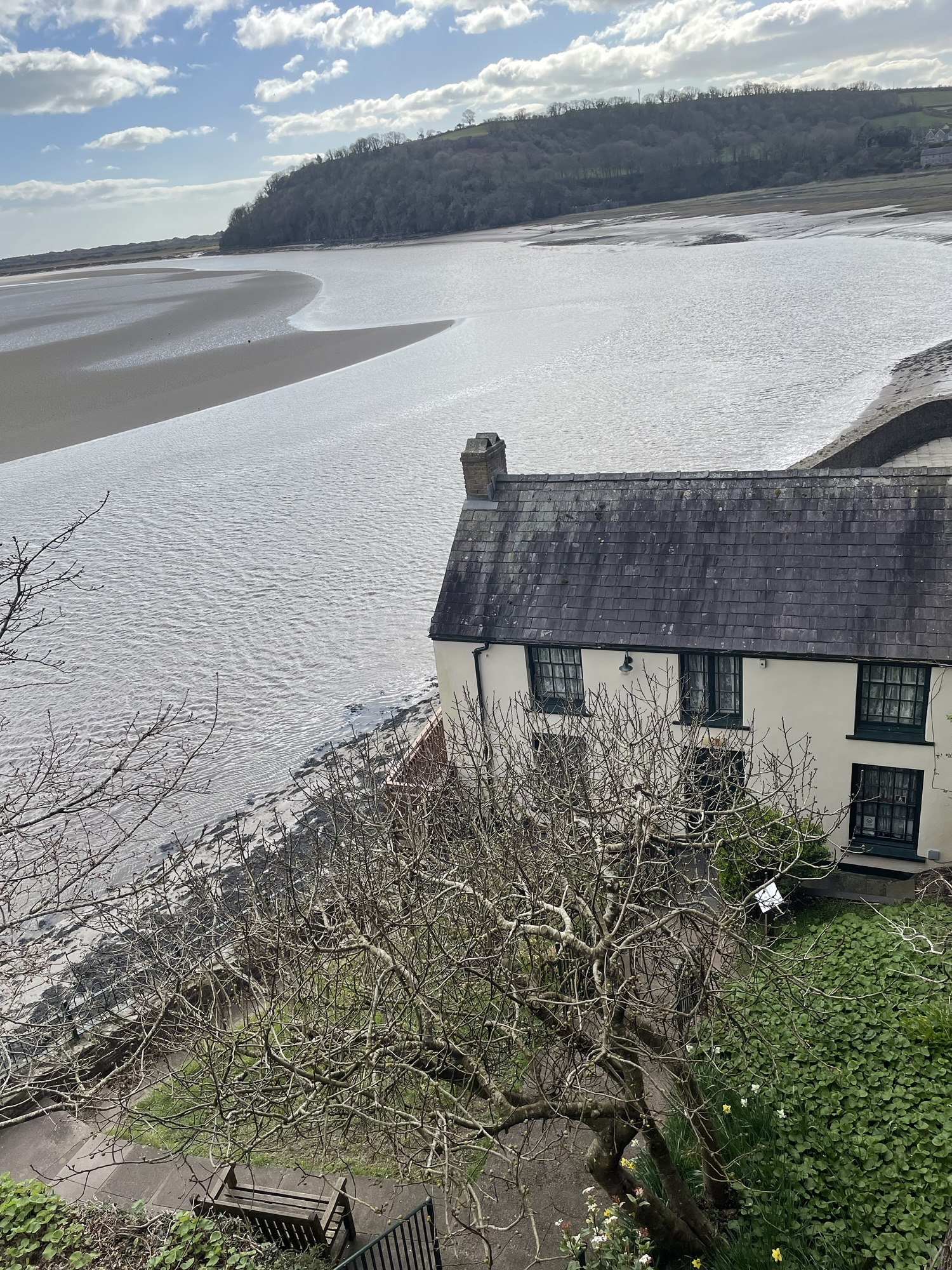
Later, Doggo and I walk up the hill at Laugharne to find Dylan Thomas’ Boat House and little writing shed which overlooks the estuary before Patrick drives us to St. Martin’s church where the poet is buried, along with Caitlin, his wife. They share a simple white cross with his name on one side and hers on the other.

“Liked their drink the pair of ’em,” said Patrick. “A bit too much, I’d say. Now, what about a pint at the Quays?”
He was right. Some years after Thomas had died in New York at the age of just 39, Caitlin wrote that “the bar was our altar” and since his death, which was due more to pneumonia than alcohol, he has been painted, and sometimes dismissed, as the boozy Welshman in the corner. But if you don’t know his work, pick up his poems and read out loud: there is such skill in the language and beauty in the rhythm. There is even one for Doggo…
‘The Song of the Mischievous Dog‘
By Dylan Thomas
There are many who say that a dog has its day,
And a cat has a number of lives;
There are others who think that a lobster is pink,
And that bees never work in their hives.
There are fewer, of course, who insist that a horse
Has a horn and two humps on its head,
And a fellow who jests that a mare can build nests
Is as rare as a donkey that’s red.
Yet in spite of all this, I have moments of bliss,
For I cherish a passion for bones,
And though doubtful of biscuit, I’m willing to risk it,
And I love to chase rabbits and stones.
But my greatest delight is to take a good bite
At a calf that is plump and delicious;
And if I indulge in a bite at a bulge,
Let’s hope you won’t think me too vicious.
It’s always a sad moment, leaving Loveston, rolling the car down the hill away from the house as Patrick waves on the road, but it has to be done. France beckons.
Doggo is strapped in, settling down for a snooze and BBC Cymru accompanies us through Jeffreystown and Broadmoor on to the A477. When we reach the bridge a couple of hours later and cross into England, I turn it off.
©Barney Spender 2025
 One Man and His Blog