
If ever I get to complete (or start) a memoir about my return to the stage, I have a feeling that it will carry the title: ‘Follow the Process’.
It was something that Nigel, my collaborator on the one-man show ‘Vive le Cricket’ which has now completed its short run in London, said to me early on when I was fretting about my aging abilities and it became something of a mantra that calmed me whenever I had a wobbly moment.
These would manifest themselves largely through my initial self-consciousness and inability to commit swathes of text to memory. As a young man I had had no such difficulties. I could swallow a part whole and then spit it out again to make space for the next role.
At Players in Trinity College, Dublin we would often be rehearsing one play, or even two, during the day and then perform another in the evening. It was normal. We would run each other’s lines and as a cast we would go for speed runs. It was both an individual and team effort.
When Alsemero dropped out one week before the opening of a production of ‘The Changeling’ I was directing, we had to make a quick change of cast which resulted in me taking on the role of Tomazo. The lines were quickly consumed although I do recall some sweaty moments on opening night when I was under the stage, swotting up on my next scene as I waited for my cue.
But that was then. I had a lively 20-something-year-old brain and I was in the habit of doing it. I had a process.
Coming back to it 40 years later, that process was lying like a rusted plough in the dark recesses of my brain. As a sports commentator, I need recall to facts of course, and it helps to recognise the players, coaching staff and so on, but it isn’t scripted. The play moves, the picture changes, you take your lead from where the game takes you. You improvise as you try to add to those pictures.
Writing ‘Vive le Cricket!’ with Nigel was, in some ways, the easy part. The stories were all there, we gave Rex his platform and both of us have plenty of experience writing scripts of different varieties. Having said that, it was thrilling to get back to drama – the last play I wrote was ‘The Breakfast Show’ back in, erm, 1986.
Again during my student days it was a one-act play, inspired more than a touch by a brilliant Lynne Parker-directed production of Caryl Churchill’s ‘Top Girls’, that threw Horatio Nelson, Robert Falcon Scott, Neville Chamberlain and Ian Botham together on the Terry Wogan breakfast radio show. It was a comic look at the notion of heroes and the thin line between success and failure. There were some laughs and it got a nice write-up in the Irish Times but that was all a long time ago.
Getting up on stage was the difficult part. I have grown reserved in the last 40 years, worried about public perception, afraid to bare myself. I had lost the joy of the imagination, of playing; instead I had grown fearful of attempting to fly in case I should fall flat on my face. I am not alone among adults of the 60+ mark in this respect. We begin to think we are too old for this kind of thing. We want to be taken seriously. More to the point other people think we are too old. For anything.
So when we began rehearsals, it didn’t feel right. I could feel myself dithering, trying to hold off the moment when I would have to stand up and start acting out the script that we had written. As a result, it was clenched-buttocks acting; wooden, considered, empty.
Over a pint in his local, the delightful Albert Arms near Elephant & Castle, I confided my fears to Nigel who I have known since those hedonistic student days.
He smiled, almost as if he had been waiting to hear this.
“Just follow the process,” he said.
“You’ve done it before. You know exactly how to work on stage. It’s all up there,” he said tapping his head. “It’s muscle memory, it will come back. But don’t think too far ahead. Just follow the process and everything will be fine.”
Follow the process. Commit to the process. So simple. Something that applies to every single person in every field of life. You hear it with young cricketers, any athlete, who lose direction when they are pushed up to international level. The advice is always to do what you were doing that attracted the selectors in the first place. Follow your process.
It’s the same I imagine for engineers, airline pilots, sea captains, astronauts, dustmen, catwalk models, even accountants… just follow the process. A full understanding of the process and knowing where it is and how it works then enables you to step off piste. James Joyce and Sam Beckett could never have played so extraordinarily with the English language if they didn’t already have a comprehensive mastery of words – in different languages – and punctuation and form.
On reflection, pilots can ignore that last part. Actually that goes for anyone in the travel business – at least when I am on board. No straying from the piste please skipper. Just stick to the process.
And so I become bolder in rehearsal, trying stuff out. Some of it works, some of it doesn’t but none of it is embarrassing. It’s exploration as we try to work out the face and voice of Rex and the other half-dozen characters that I’m playing.
REVELATION
At first I was worried that I wouldn’t be able to differentiate enough between them but by following the process and taking it step by step they gradually revealed themselves. They were indeed different shades. They not only had individual accents and speech patterns but held themselves differently on stage, to the point where the audience would only need to see a change of stance to recognise a different character was about to speak.
This was a thrilling revelation. The process was working.
As for the lines, Nigel was right about muscle memory. And I remembered that in spite of all the help that we gave each other as students, the only way to learn lines is to sit in a quiet room or in the garden with no distractions and get on with it.
Read, repeat; read repeat. Ad infinitum. And that’s not just me saying that.
“So much of it really is a matter of repetition, of saying the lines over and over again until you’re sick of them,” says Michael Caine, who claims to read his lines a minimum of 1,000 times before he sets foot on a set.
I don’t know if I managed that many repeats but it can’t have been far off.
I would use dog walks as a time to go over the full text which in the end even got to Doggo.
“Molière is much funnier,” he would tell me at any given opportunity.
I recorded the script so had my phone handy if I fumbled a line. Sometimes I would play the recording and do the lines along with it. At night I eschewed ‘The Archers’ and went to sleep to my own voice.
Yes, it’s boring. But it’s the process.
To go hands free in rehearsal is a true Liberation Day, you stop worrying about knowing the lines and focus more on how they are coming across and do they work. Nigel and I did major tinkering with the script but this was never a crisis because at all times we were following the process. The changes were logical and tighter, easier for me, or Rex, to convey.
The other thing we started doing was a warm-up. This is just as important for the actor as it is for the athlete. It’s about the physical, of course, and the vocal but it’s also about getting the head right. I had to find myself in a space where I could take a back seat and Rex would slide in.
Nigel introduced me to a series of basic Tai-Chi exercises, good for stretching and for breathing. We would do this each time on stage before the audience came in.
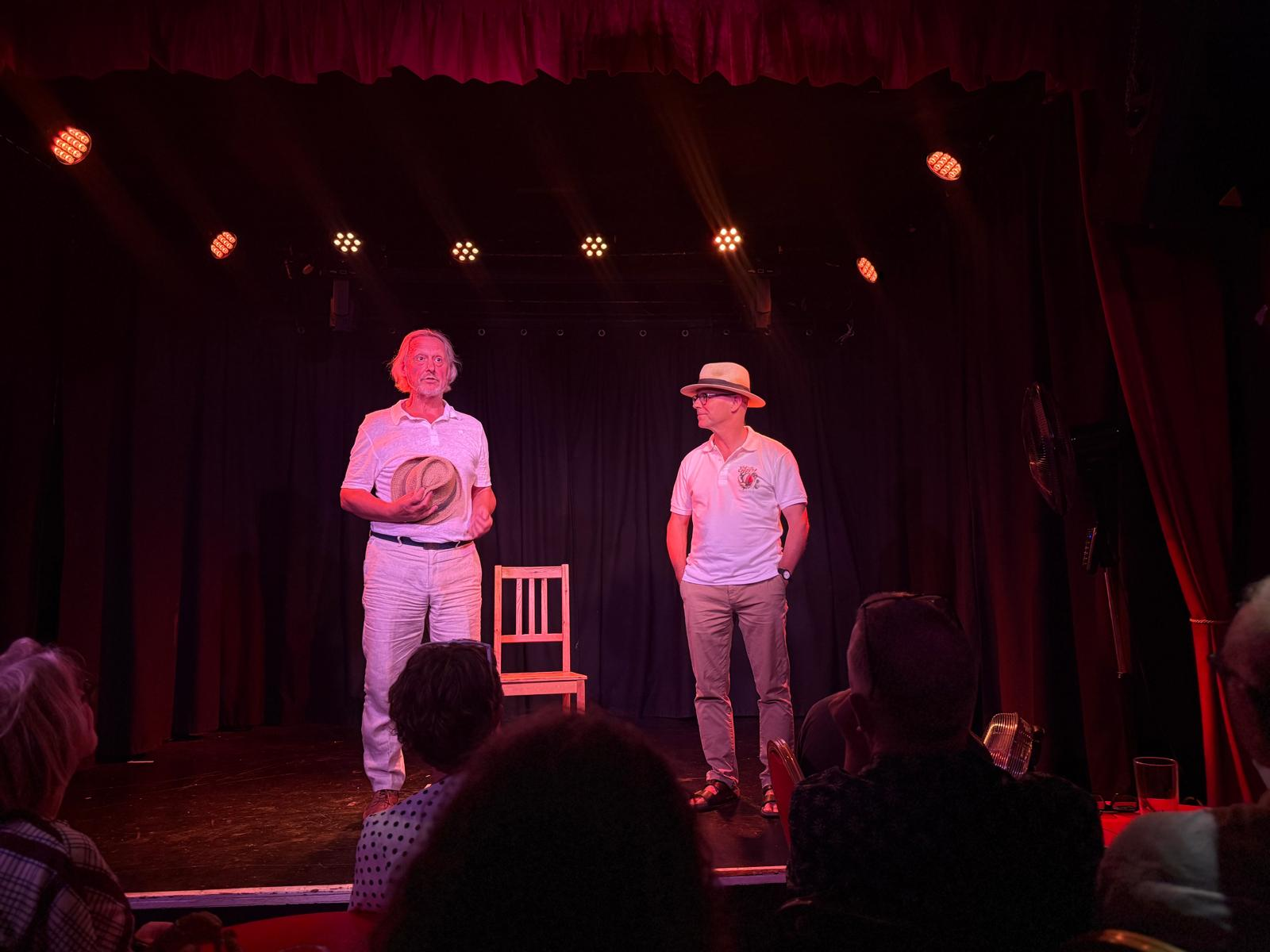
“Hug the tree,” Nigel would whisper. “Push the baby into the river” and so on.
And then I was on my own in the dressing room, tiny cupboards generally, where I would change into the Rex costume, have a pee, do some tongue-twisters, some more stretching, have another pee making sure not to splash on my linen trousers, try not to listen to the burr of the audience as they begin to take their seats, eat half an apple, get some lip balm on, sip some water, have another pee, step up to the curtain as I listen to Nigel making his introductory piece…
And then it’s showtime. Bustling from the back of the auditorium between the chairs and tables, muttering my tongue-twisters again, this time as Rex’s opening lines of the play, up on stage and turning to look out across the audience, so many faces looking up at me, expecting an hour of entertainment.
A pause.
Just follow the process…
“Hi my name’s Rex. I live in Paris and I commentate for French television. In French. On cricket.”
Cue first laugh… chocks away and three cheers for the process.
@Barney Spender 2026

